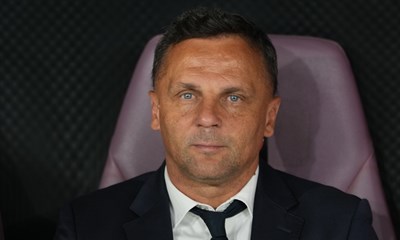
As well as leading Argentina to World Cup
glory as coach in 1978, César Luis Menotti led FC Barcelona during the
1983-1984 season, and several other top clubs throughout his career,
including River Plate, Boca Juniors and Santos FC. Menotti recently sat
with El País to harp on the beauty of Guardiola’s game,
Argentina’s aggression toward Messi and the sea of Mourinhos in the
modern game. Read on for the conclusion of a truly epic interview.
P. In Argentina, could there not be a figure like Guardiola?
R.
No, there is only one Guardiola, but if there were, they would not let
him exist. He would be assassinated before he could exist. What we have
here are Mourinhos or guys like him, who only think about winning and
when they lose, it’s not their fault. We’ve known about his type for a
long time. He has very large contradictions. Recently a friend went to
Spain and attended Mou’s trainings. He also went to see Pep’s. He said
they do not train so differently, that what they do is very similar. Mou
trains very well. Conceptually, they are very similar. But on the
field, at the hour of truth, they have nothing in common. There are many
Mourinhos. There is only one Guardiola. Barça and the Spanish national
team have been a great benefit to football, and I thank them for it. In
the end, Luis Aragones decided to be a bullfighter and not a bull. I
said that once, that Spain[’s football] should be defined and he got
mad, but I really like Luis …
P. Del Bosque said that he wanted to be like Busquets, the tallest. And you, who did you want to be?
R.
What Busquets has done is clear. He’s one of the biggest talents that
Spanish football has given us. He’s a discovery. The first time I saw
him, I called a friend and told him, “I have seen a footballer of a lost
species.” He’s a crack. The best I’ve seen in my life is Pelé. I
suppose I would’ve liked to be Pelé. He was capable of surprising you,
like when he’d go up for a header, he’d go up just a bit more and stop
the ball with his chest. You never knew what he was going to do.
P. Like Messi…
R.
I think there have been four kings of football and the fifth has not
yet appeared. Di Stéfano, Pelé, Cruyff and Maradona. Now we are waiting
for the fifth, who might be Messi, or at the moment, might not be
anybody. He’s the closest. But we can’t give him the crown for at least
five years. To give Messi the crown, we would have to see him outside of
Barcelona, doing what Maradona did at Napoli. That team was a band that
he converted into an orchestra. Messi is a treasure, a marvelous thing,
but we’ll have to see what happens. He doesn’t have to demonstrate
anything to be the best in the world [of his time]. But he’s missing one
more step to be the best. I don’t doubt that he could claim the crown
of the fifth king, but not yet. However, do you know what’s even better?
P. No…
R.
That Messi learns. Before, every time he got the ball, he would think
about how to win the game. No longer. He has evolved. That’s how you
notice the touch of the master. What would have become of these players
without Pep? Could you imagine Piqué without Pep?
P. I could not.
R.
Piqué is Franz Beckenbauer. He’s a footballer of tremendous talent. But
I doubt any other couch would’ve given him the permission that Pep has
given him. This isn’t freedom. You don’t give freedom to anyone on the
pitch. You gain it from knowledge. In your profession you go and give
liberty to any idiot and they’ll ruin you in the paper. It’s the same
thing. You have to tell the players what to do because they will not do
it themselves. They play freely within a concept and with functionality.
Piqué does not do whatever he feels like doing. Within Barça there is
no absolute freedom. There are standards that permit the players to let
them be very free and very happy, but there are standards.
P. You are referring to the 4-2-3, 3-4-3…
R.
No, that’s a phone number. 4-2-3-1, 3-4-5-1… Once they asked Di Stéfano
how it was possible to play a 2-3-5 and he responded: “What do you
think, that before we were just some assholes with two guys defending
against five?”
P. You met with Pep a few years ago when he wanted to be a coach. What did you see in him?
R.
One thing he did differently: he came here with a very clear idea. He
didn’t come like others asking me to inspire them, directing them down
some path as if I were a Messiah. He came and left with his idea. I’m
bored with talking to young coaches who come seeking the truth. Pep
didn’t come searching for us to tell him what to do. He already knew. It
worries me because now they are waiting to fire at him.
P. Well, I think he has assumed that since the first day.
R.
He has an advantage, however—his past, which no one can change. In
one’s memory, one takes from the past the things that serve him. If one
did not have a past, the present would serve no use. Madrid can sign
more and more and will eventually have everyone and win, but the 5-0
clásico at the Camp Nou is for the rest of his life. I try to think and
can not come up with a game like that one—that I’ve seen or participated
in. He conquered Mourinho for the rest of his life.
P. You said that after that, they screwed up.
R.
In my neighborhood, we call it shitting on your paws. He shat himself. I
saw the next game with Higuaín, Adebayor, Benzema and Kaká on the bench
and thought: sure, he wins, but he re-shat himself. It’s the biggest
cowardice I’ve seen in a long time. And in Madrid, it’s unprecedented.
The bull was not killed and the bull fighter ran away and never even got
close to the bull again. But it’s very tough what happened. It’s very
difficult to recall who ever came out of a clásico that humbled. I can’t
recall. It’s very tough, eh, very tough.
P. What’s going on with Argentina being so bad to Messi?
R.
When I say that Argentine soccer has suffered a deculturation, I am not
referring to Borges. The football culture used to be that if you did
poorly, they would scrutinize all ten players. I remember one day I drew
a foul with one minute remaining in the game. Everyone ran forward to
head the ball in. On the goal line, there was a defender and he stopped
the ball. For a whole month I was jeered, “If there’s a free kick,
Menotti is taking it.” Look, do you know what’s going on with Argentina?
P. I hear you.
R.
Football is like life. You don’t wake up at six in the morning looking
for the woman of your life. You find her or you don’t. Each time you
touch the ball, they want to win the game. It’s terrible, a verticality,
a fright. Why have an enganche [playmaker] if we do not have anyone to
pass to? In Barcelona there are plenty of assisters who have people to
pass to. There are more passes than goals. And that’s what they try to
do, to pass the ball. It’s not that hard. I know Batista has good
intentions but…
P. He wants them to play like Barcelona.
R.
Morons. What do they think, that it’s easy to sing like [Juan Manuel]
Serrat? No, it’s impossible. Do you know that [Batista] called me as
soon as I got out of the hospital? I love the guy, but he really tests
me. He said to me, “Hey, old man. Why don’t you stop screwing yourself
and dedicate yourself to something more important in life than smoking?”
P. And did you listen to him?
R.
I don’t smoke and I am trying to write a book based on what I have
written and the interviews I have saved. I do not know what will come of
it, nor what mysteries of football I will discover.
[uredio RodmanST - 21. srpnja 2011. u 09:50]